


Introduction
Modular data centers compress power, cooling, and deployment demands into spaces where standard rack power hardware often falls short. A smart PDU must fit tight cabinet layouts, tolerate high temperatures and transport vibration, and still provide accurate metering, redundancy support, and outlet-level control. This article explains how to define practical PDU requirements for prefabricated and edge environments, from form factor and load planning to monitoring, switching, and environmental resilience. It sets up the key decisions needed to specify a customizable power distribution solution that supports reliable operation without wasting space, capacity, or budget.
How to Define Smart PDU Requirements
As someone who has spent years configuring modular data centers, I can tell you that off-the-shelf power setups rarely cut it. When you are dealing with tight spaces, rapid deployment schedules, and unique cooling constraints, you need a highly intentional smart PDU strategy. Let’s break down how to nail those requirements right out of the gate so you don’t end up with expensive paperweights.
Custom PDU Requirements for Prefabricated and Modular Data Centers
Prefabricated modules operate under strict dimensional tolerances that traditional brick-and-mortar facilities simply don’t have. For instance, a standard 42U or 45U rack in a modular container might only have 2.5 inches of clearance in the rear channel. This is exactly where modular data center power strategies shift toward ultra-low-profile or zero-U designs. Because these modules are often deployed in harsh edge locations, you are typically looking at operating temperatures hitting 60°C (140°F) in the hot aisle. The PDU’s internal components—relays, controllers, and wiring—must be rated for these high-heat environments to prevent premature failure. I always specify a ruggedized aluminum chassis over plastic, not just for thermals, but to withstand the intense vibration these units endure while the modular container is being transported on a flatbed truck to the site.
Load, Redundancy, Metering, and Outlet-Level Control
Let’s talk hard numbers. High-density modular racks for AI or dense virtualization frequently push 15kW to 25kW per cabinet, requiring three-phase 32A or 60A inputs. To maintain 99.999% uptime, you absolutely need an A/B feed redundancy setup. When specifying metering capabilities, you have to decide if you need 1% billing-grade accuracy at the inlet level for general capacity planning, or highly granular outlet-level monitoring to track individual server draw and allocate costs to specific clients. From my experience, outlet-level control (remote switching) is an absolute lifesaver. When you need to remotely reboot a hung server at an unmanned edge computing site 300 miles away, that switching capability pays for the entire PDU in a single avoided truck roll.
Which Smart PDU Specifications to Compare
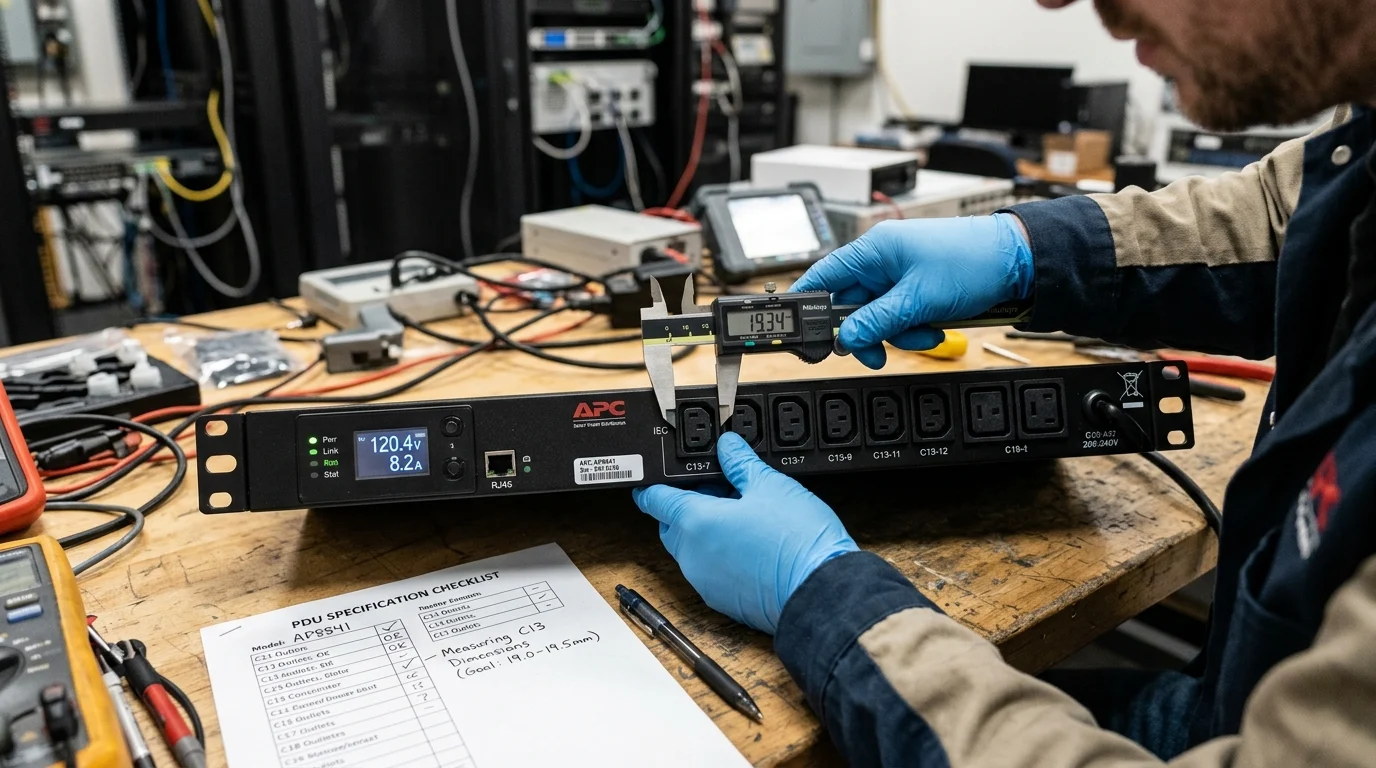
Once you have mapped out your broad capacity and form-factor requirements, it is time to get into the weeds of the spec sheet. I always tell my team to compare apples to apples across vendors, because a minor oversight in physical or digital specs here can lead to a major headache during the physical installation phase.
Form Factor, Input Plugs, Branch Circuits, and Outlet Layout
Physical specifications matter immensely. You might need a tailored rack PDU that perfectly matches your rack’s height—say, a customized 72-inch vertical unit that maximizes outlet density. Input plugs usually range from NEMA L6-30P for standard 208V setups to IEC 60309 for heavy-duty three-phase power. Branch circuit breakers must be UL 489 rated for safety and easily accessible without tools. When it comes to the layout, mixing C13 and C19 receptacles in alternating, color-coded blocks is my go-to move for flexibility and error reduction. Here is a quick breakdown of common power densities and their typical plug pairings to help you baseline your specs:
| Power Density | Typical Input Voltage/Phase | Common Input Plug | Suggested Receptacle Mix |
|---|---|---|---|
| Low (Up to 5kW) | 120V / 208V Single-Phase | NEMA L5-30P / L6-30P | 20x C13, 4x C19 |
| Medium (5kW – 10kW) | 208V Single/Three-Phase | IEC 60309 32A | 24x C13, 6x C19 |
| High (10kW – 25kW+) | 400V / 415V Three-Phase | IEC 60309 60A / 63A | 30x C13, 12x C19 |
Monitoring, Switching, Environmental, and Network Features
Beyond delivering raw power, your smart PDU acts as the nervous system of the rack. I prioritize units with hot-swappable network management cards (NMCs). This means we can upgrade firmware or replace a faulty controller without dropping power to the critical load. Look for robust daisy-chaining capabilities—linking up to 16 PDUs on a single IP address saves a fortune on top-of-rack switch ports. Furthermore, ensure the PDU supports plug-and-play environmental sensors. I usually deploy at least two temperature and humidity sensors per rack (top and bottom) to ensure we stay within ASHRAE’s recommended 18°C to 27°C envelope. For specific outlet configurations, ensure the manufacturer uses bi-stable relays; they consume zero power to hold their state, which reduces the PDU’s own energy footprint by up to 30% and significantly lowers internal heat generation.
How to Source, Validate, and Scale Custom Smart PDUs
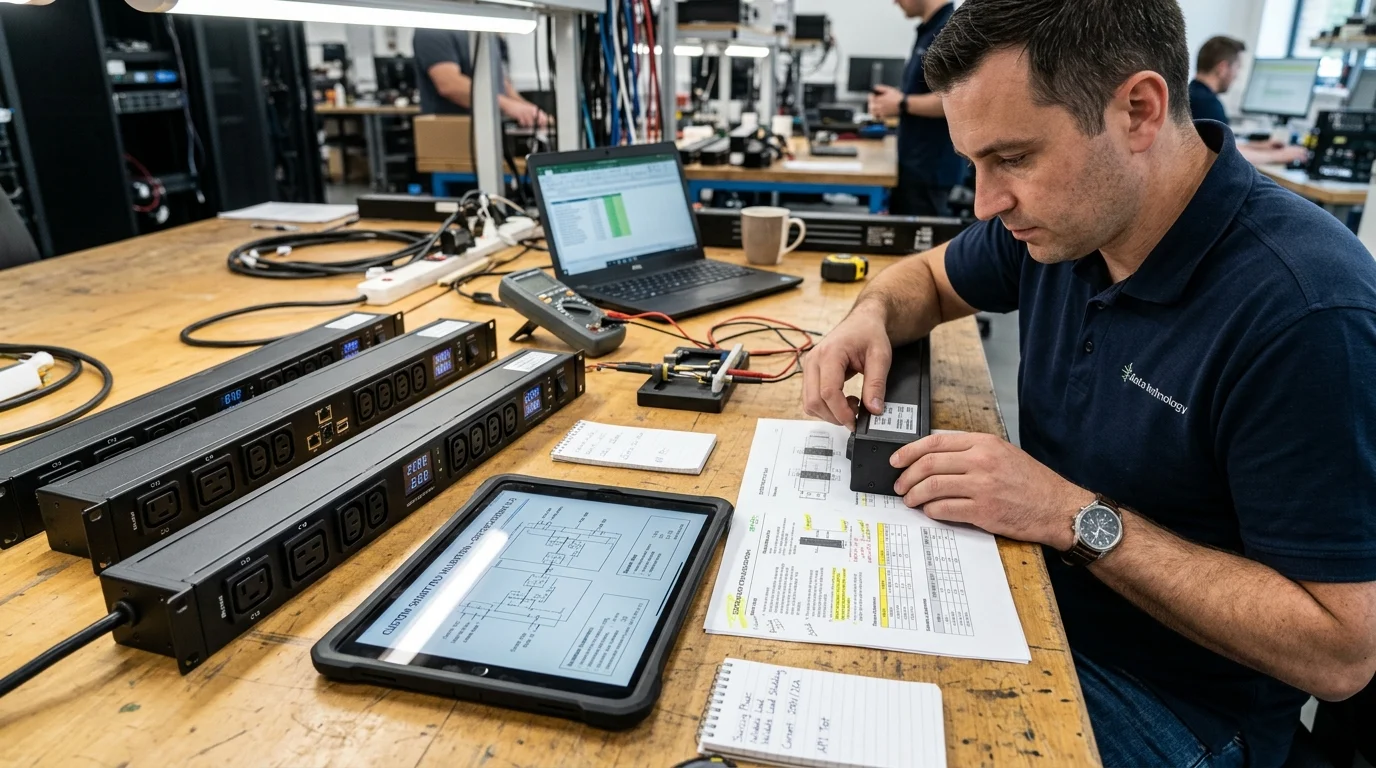
Finding the right partner to build and deliver your units is just as critical as the engineering phase. You need a supply chain that can keep up with your aggressive modular deployment schedule without cutting corners on quality or safety.
Compliance, Testing, Lead Time, and Documentation
When you evaluate an OEM PDU manufacturer, their compliance certifications are completely non-negotiable. I look for strict adherence to UL 62368-1 for North America and CE/RoHS for European deployments. Ask hard questions about their factory testing protocols; every single unit should undergo 100% Hi-Pot (high potential) and ground bond testing before it ever hits a shipping pallet. Lead times can literally make or break a modular data center project. While standard off-the-shelf units might ship in 2 weeks, a true custom PDU design typically requires a 6- to 8-week lead time for the First Article Inspection (FAI) unit, followed by 4 weeks for volume production. Don’t forget the digital documentation—demand comprehensive 3D CAD models and SNMP MIB files upfront so your DCIM integration team can start mapping the software before the hardware arrives.
Final Smart PDU Selection Checklist
To wrap things up, I rely on a strict validation checklist before signing off on a large purchase order.
Key Takeaways
- The most important conclusions and rationale for Smart PDU
- Specs, compliance, and risk checks worth validating before you commit
- Practical next steps and caveats readers can apply immediately
Frequently Asked Questions
Why choose a custom smart PDU for modular data centers?
Modular data centers often have tight rack clearance, high heat, and vibration during transport. A custom smart PDU can match exact rack dimensions, outlet layouts, input plugs, and ruggedized chassis requirements.
What power capacity should a smart PDU support for high-density racks?
AI or dense virtualization racks often need 15kW to 25kW per cabinet. Three-phase 32A, 60A, or 63A inputs are commonly specified depending on voltage and site design.
Is outlet-level switching useful in edge data centers?
Yes. Outlet-level switching lets teams remotely reboot hung servers at unmanned edge sites, reducing truck rolls and downtime while improving operational control.
What outlet mix is best for a tailored rack PDU?
A mixed C13 and C19 layout is usually best. C13 supports standard IT devices, while C19 handles higher-power equipment. Color-coded outlet groups can reduce cabling errors.
Can YOSUN provide customizable smart PDU solutions?
Yes. YOSUN offers smart PDU and rack PDU options that can be tailored for form factor, input plug, outlet mix, metering, switching, and modular data center deployment needs.
Post time: Apr-22-2026


