

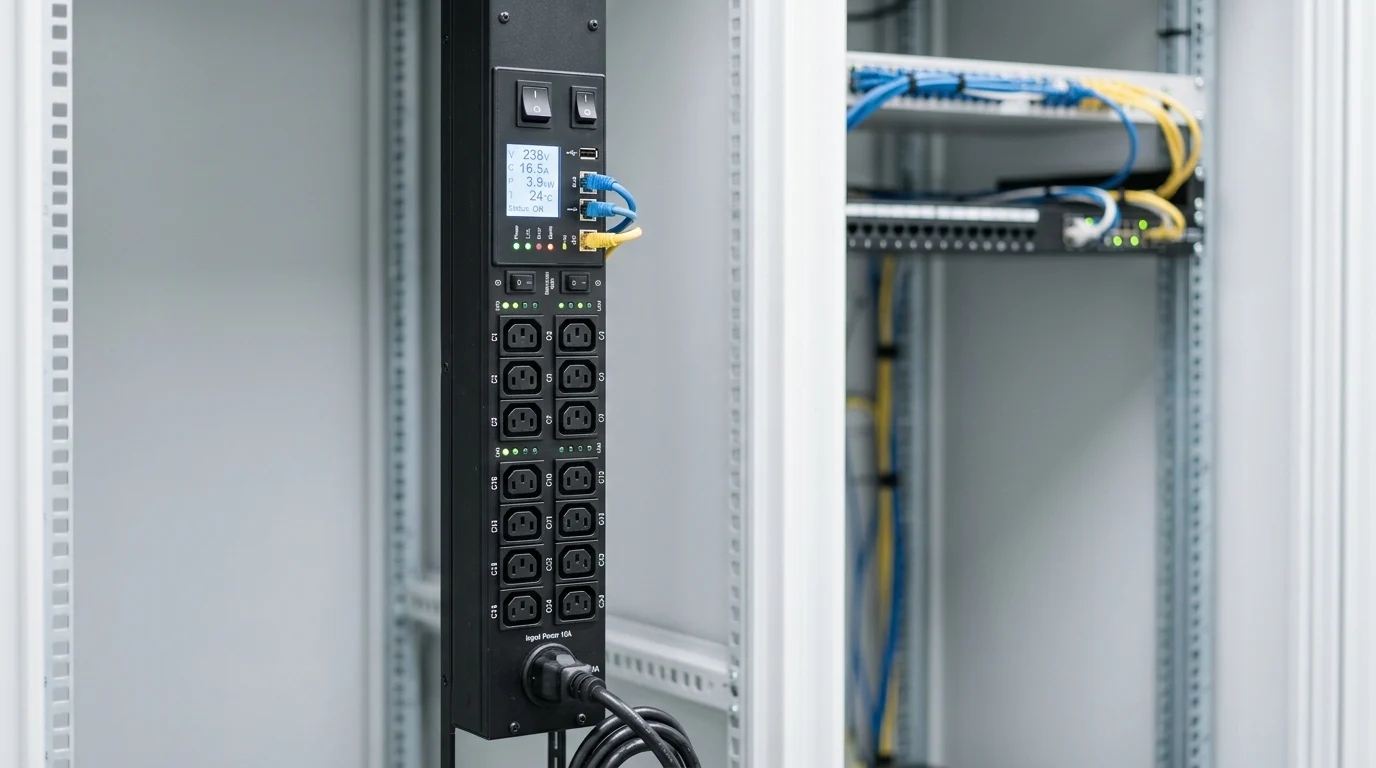
Introduction
Rack power behavior often reveals equipment trouble before traditional monitoring tools do. Modern Smart PDUs collect detailed electrical data—current, voltage, load balance, temperature, and power quality—and AI can turn those signals into early warnings. This article explains how predictive maintenance works at the PDU level, what patterns indicate possible server or power supply failure, and why data centers are using intelligent power distribution to reduce unplanned downtime, improve maintenance timing, and protect critical infrastructure.
How Smart PDUs Turn Rack Power Data into Predictive Insights
I’ve spent enough time in data centers to know that unexpected downtime is the ultimate nightmare. We used to treat power distribution units as dumb iron—just a heavy-duty way to get electricity from the UPS to the servers. But today, a Smart PDU does so much more. By layering artificial intelligence over raw electrical metrics, we’re shifting from a reactive “what just broke?” mindset to a proactive “what’s about to break?” reality.
In an industry where an unplanned outage can cost upwards of $9,000 per minute, waiting for components to fail is no longer a viable strategy. AI-driven monitoring is transforming rack power distribution into the first line of defense for equipment health.
What Predictive Maintenance Means in a Smart PDU
When we talk about predictive maintenance at the rack level, we aren’t just talking about basic alarms. We’re talking about machine learning algorithms analyzing historical power draw to forecast hardware failures before they happen. For example, instead of waiting for a server to drop offline unexpectedly, Predictive power analysis can detect power supply unit (PSU) degradation up to 14 days in advance.
It achieves this by tracking micro-fluctuations in current draw, harmonic distortion, and subtle shifts in impedance that occur when internal capacitors start to fail. I’ve seen facilities save tens of thousands of dollars simply by swapping a redundant PSU during a scheduled maintenance window rather than dealing with a cascading failure at 2 AM.
Which Smart PDU Signals Prevent Equipment Failures
So, what exactly is the AI looking at to make these calls? The most critical signals usually combine electrical and environmental telemetry at a highly granular level. A sustained temperature increase of just 2°C at a specific outlet, coupled with a 5% drift in power factor, often indicates a failing server fan or a clogged intake bezel.
With Smart power sensing, the system captures these subtle anomalies—like a brief 10-millisecond voltage sag or a minor current spike during a steady workload—that human operators would easily miss. By continuously monitoring the crest factor and active power metrics, the PDU turns raw voltage and amperage logs into actionable maintenance tickets, allowing technicians to intervene long before a thermal runaway or hard crash occurs.
Where AI-Enabled Smart PDUs Outperform Traditional Monitoring
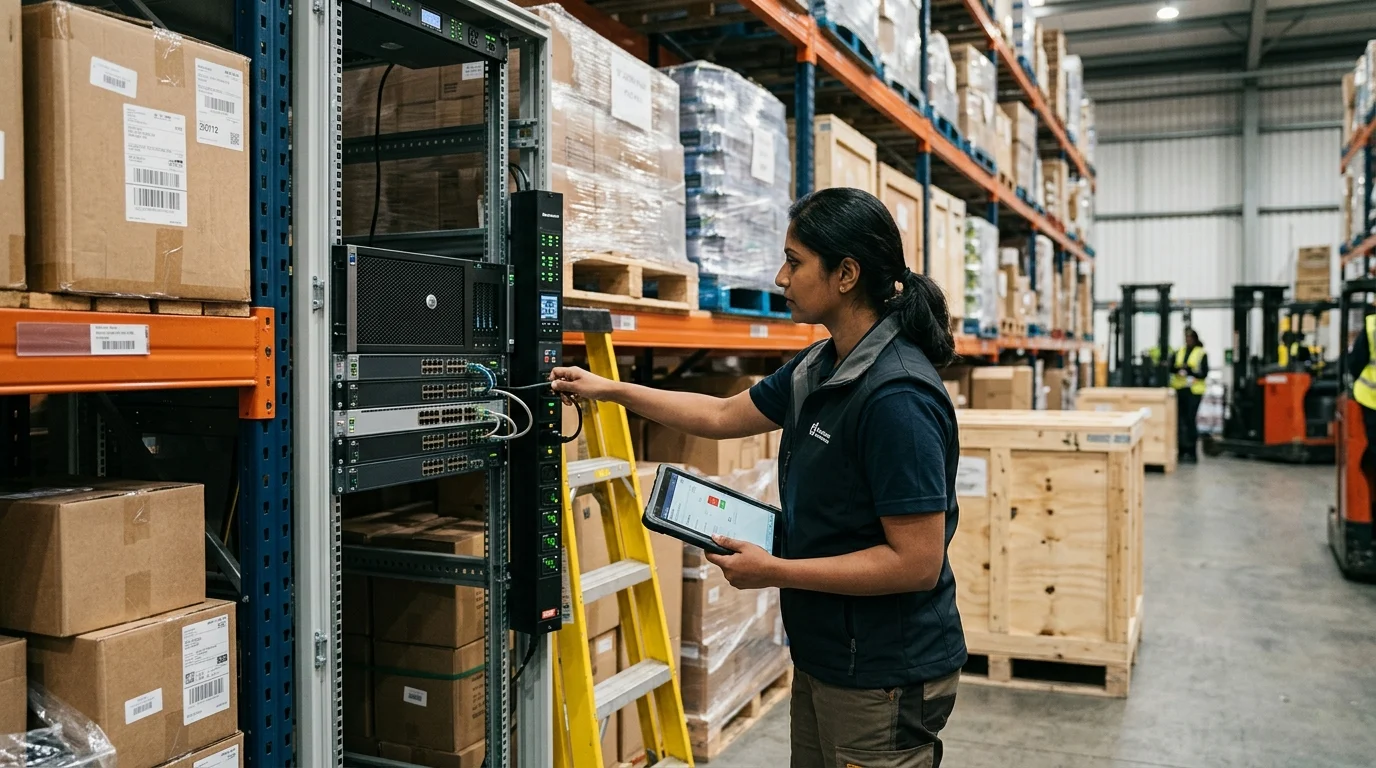
I remember when getting an SNMP trap email about a tripped breaker was considered cutting-edge facility management. Back then, we relied entirely on static thresholds. If a circuit hit 16 amps, an alarm went off, and someone had to sprint to the server room. The problem with that approach? By the time the alarm triggered, the thermal event or hardware failure was already happening.
AI flips this script entirely, moving us from a break-fix model to true predictive intelligence. It allows us to stop reacting to emergencies and start managing hardware lifecycles intelligently.
Threshold Alerts vs Trend Analytics vs AI Insights
To really understand the leap forward, we have to compare the evolution of rack monitoring. Static alerts only tell you when a boundary is crossed. Trend analytics give you a historical slope, but an AI-integrated PDU actually understands the context of the workload and the specific power signatures of your hardware.
| Monitoring Method | Data Utilization | Trigger Mechanism | Typical Reaction Time |
|---|---|---|---|
| Threshold Alerts | Real-time snapshots | Hard limit (e.g., >80% load) | Reactive (Failure imminent or occurring) |
| Trend Analytics | Historical averages | Linear projection | Proactive (Days/Weeks notice) |
| AI Insights | Contextual & historical | Pattern anomaly (e.g., 45% load but irregular waveform) | Predictive (Weeks/Months notice) |
Traditional setups wait for that 80% capacity mark to blast your inbox with warnings. However, an AI model can flag an anomaly at just 45% load if the waveform signature matches a known failure state for a specific server model. It knows the difference between a normal CPU spike during a batch processing job and an abnormal power draw caused by failing silicon.
Key Features for Evaluating Intelligent Rack PDUs
If you’re evaluating these systems for your own racks, you need hardware that can actually feed the AI accurate, high-resolution data. Look for units that offer billing-grade metering with at least 1% accuracy across voltage, current, active power, and apparent power metrics.
You also want high-density environmental sensor ports to track temperature and humidity at the top, middle, and bottom of the rack. Ultimately, maximizing Equipment uptime depends entirely on how granular your data is. The most sophisticated AI model in the world is useless if the PDU is only polling data every five minutes; you need edge intelligence capable of real-time, sub-second telemetry sampling.
How to Deploy AI-Enabled Smart PDUs Effectively
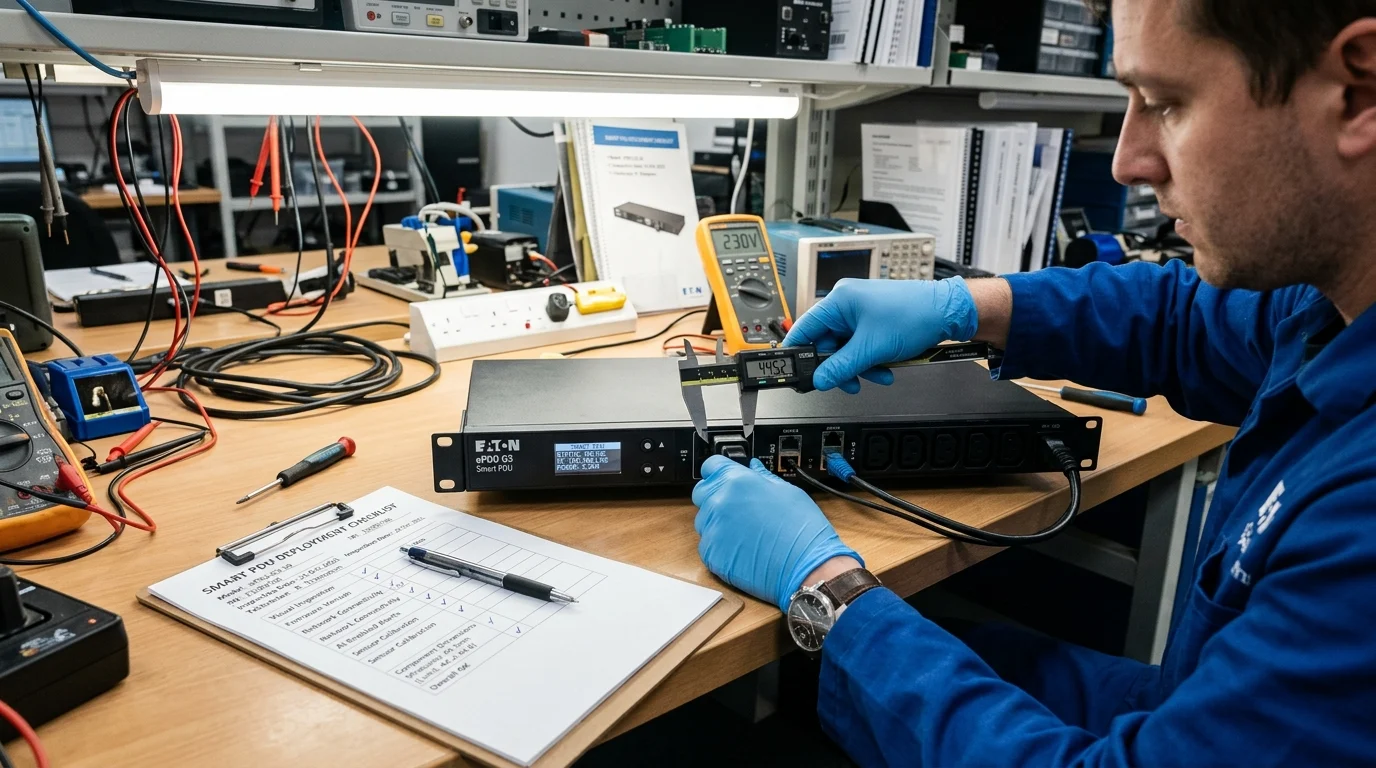
Buying the hardware is only half the battle. Over my career, I’ve seen plenty of facilities install top-tier intelligent rack hardware, only to use it as a basic remote-reboot power strip because they didn’t know how to deploy the analytics effectively.
Getting real predictive value requires a deliberate rollout strategy that bridges the gap between your physical facilities team and your IT operations.
Practical Steps for Turning Smart PDU Data into Reliable
Actions
You can’t just flip a switch and expect perfect predictions on day one. I always recommend running a baseline data collection period of 30 to 45 days. This training phase gives the machine learning models time to learn the normal rhythmic power cycles of your specific workloads, accounting for daily peaks and weekend lulls.
Once the baseline is set, you can start mapping AI alerts to your IT service management (ITSM) tools.
Key Takeaways
- The most important conclusions and rationale for Smart PDU
- Specs, compliance, and risk checks worth validating before you commit
- Practical next steps and caveats readers can apply immediately
Frequently Asked Questions
How does a Smart PDU support predictive maintenance?
It continuously tracks outlet-level power, temperature, current, voltage, and waveform changes, then uses AI to spot abnormal patterns that may indicate failing PSUs, fans, or overloaded circuits before downtime occurs.
What Smart PDU data is most useful for preventing equipment failure?
Useful signals include current draw, voltage sags, power factor drift, harmonic distortion, outlet temperature, crest factor, and active power trends. Together, they reveal early signs of hardware or cooling problems.
Why is AI better than simple threshold alerts in rack power monitoring?
Threshold alerts only react when limits are crossed. AI analyzes normal behavior, workload context, and historical patterns, so it can flag unusual power signatures even when usage is still below alarm limits.
Can a Smart PDU help reduce unplanned data center downtime?
Yes. By detecting early electrical and thermal anomalies, a Smart PDU helps teams replace weak components during planned maintenance instead of responding to emergency outages.
What should I look for when choosing a Smart PDU for AI monitoring?
Choose models with outlet-level metering, environmental sensors, remote monitoring, SNMP or network integration, reliable logging, and scalable management features suited to your rack power distribution needs.
Post time: Apr-22-2026


