


What exactly are Power Distribution Units? I see them as the unsung heroes of modern infrastructure. They manage and distribute electrical power to your crucial equipment. Why are Power Distribution Units so critical today? Well, the global market for these devices was valued at billions in 2024, showing their huge importance. I believe they are essential for keeping our digital world running smoothly.
Key Takeaways
- PDUs are advanced power devices. They do more than basic power strips. They manage and distribute electricity to important equipment.
- PDUs help keep systems running. They prevent power problems. They also save energy and allow remote control.
- Different types of PDUs offer various features. Some monitor power use. Others allow remote control of outlets. This helps businesses grow and adapt.
How Power Distribution Units Function
Beyond Basic Power Strips
When I talk about Power Distribution Units, I often hear people ask, “Aren’t they just fancy power strips?” I understand why you might think that, but let me tell you, they are so much more! A basic power strip gives you a few extra outlets and maybe some surge protection. That’s it. PDUs, on the other hand, are built for serious work.
Think about it this way:
| Feature | PDU | Power Strip |
|---|---|---|
| Outlet Quantity | Multiple, often more than 8 (up to 48) | Limited, usually up to 8 (2 to 8) |
| Functionality | Advanced, with remote monitoring, load balancing, etc. | Basic, plug-and-play |
| Power Ratings | Designed for higher power loads, suitable for industrial applications, often supports three-phase power | Typically rated for lower power loads, appropriate for home and office use |
| Application Environment | Industrial, data centers, server rooms | Homes, offices |
| Size | Larger, suitable for complex configurations | Smaller, designed for simpler setups |
| Mounting Options | Flexible, can be mounted in equipment racks | Limited, typically for home/office use |
| Surge Protection | Often robustly included | Not typically comprehensive |
| Overload Protection | Industrial-grade resettable circuit breakers | Basic fuses, if any |
| Thermal Protection | Built-in temperature monitoring | Basic, if any |
| Risk of Electrical Fires | Significantly reduced | Higher due to lack of features |
| Monitoring Capabilities | Real-time tracking of voltage, current, power consumption; alerts for unusual patterns; data logging | Not typically available |
| Remote Management | Control outlets remotely (on/off), schedule power cycles, integrate with environmental sensors | Not typically available |
I see PDUs as having specific features that go way beyond simple surge protection. For example, they offer:
- Outlet Control: I can manage individual outlets. This helps me address unresponsive equipment or extend runtime during power failures.
- Hot Swappable: I can update monitoring capabilities without interrupting power. That’s a huge plus!
- Environmental Monitoring: They integrate sensors for temperature, humidity, airflow, door position, and even liquid detection within the cabinet. This gives me a full picture of the environment.
- Daisy Chain Capabilities: I can connect multiple devices (up to 50) using just one IP address. This really simplifies deployment.
- Remote Connectivity: I get network or serial access for remote power consumption monitoring and configurable alerts.
- Ulock Outlets: These secure power cords to prevent accidental disconnections. They even have color-coded receptacles for circuit identification.
PDUs also come with different gauge ratings. Power strips usually use 14 AWG wires for medium-duty appliances. PDUs, however, offer multiple gauge ratings from 14 AWG to 6 AWG. This gives me much greater flexibility for various appliance types. Plus, PDUs have domestic and international-grade inlets and outlets (like IEC 60309, IEC C13/C19). You won’t find those on a typical power strip.
Core Power Delivery and Management
At its heart, a PDU is all about getting power where it needs to go, safely and efficiently. It’s a device with multiple outputs. It distributes electrical power, especially to racks of computers and networking equipment in data centers.
Let me break down some of the fundamental electrical components you’ll find inside:
- Remote control connections: These allow me to access the power system remotely.
- EMI filters: They prevent electromagnetic noise from messing with the power line.
- Control board: This board lets me reconfigure the unit and see metering parameters.
- Auxiliary output: I use this for monitoring breaker status and connections.
- Main output: This is the primary power distributor to all connected devices.
- AC inlet and outlet: These provide connections for detachable AC line cords and additional power access.
- GFI module: Ground-fault interrupters are there to prevent electrical accidents.
- Relays: They help with switching and monitoring power across multiple devices.
- Main circuit breaker: This manages the PDU’s power source.
PDUs perform several primary functions for power delivery:
- Efficient Power Distribution: They distribute power from a central source to multiple devices like servers and racks. This ensures each system gets the power it needs and prevents overloads.
- Load Balancing: PDUs evenly distribute power across devices within a rack or server. This prevents circuit overloads, power failures, and equipment damage by intelligently managing power flow.
- Power Monitoring: Modern PDUs include tools to track voltage, current, and power usage in real-time. This helps me identify inefficiencies, detect faults, and optimize energy consumption.
- Surge Protection: PDUs often have built-in surge protection. This shields sensitive equipment from voltage spikes caused by electrical faults or lightning. It prevents downtime and costly repairs.
- Remote Management: Smart PDUs let me monitor and control power distribution remotely. I can manage devices, perform diagnostics, and adjust settings without being physically present.
- Energy Efficiency: By integrating features like power monitoring, load balancing, and surge protection, PDUs help reduce wasteful energy consumption. They improve the overall energy efficiency of data centers.
Some advanced PDUs, like Metered Auto Transfer Switch (ATS) PDUs, distribute unfiltered electrical pass-through to receptacles from redundant plugs. They can connect to separate power sources for redundancy. If the primary power source fails or exceeds set thresholds, the PDU automatically switches to the secondary source. This maintains continuous operation. I can see the current draw displayed on an LCD for real-time monitoring. Switched ATS PDUs are similar but also offer remote or local control over individual outlets. Then there are Maintenance Bypass PDUs. These facilitate the seamless transfer of electrical load from UPS power to utility power. This ensures uninterrupted operation during UPS maintenance, battery replacement, or new UPS installation.
Key Operational Benefits of Power Distribution Units
I’ve seen firsthand how Power Distribution Units transform IT infrastructure. They offer measurable benefits that directly impact efficiency and cost.
First, they lead to improved data center management. PDUs track, control, and regulate power usage. This means increased efficiency and dependability, reduced operational expenses, and enhanced overall performance. I can even detect and reboot crashed systems remotely, which eliminates the need for on-site visits. I can also remotely shut down unused IT equipment to save energy and reduce our carbon footprint.
Next, we get great power monitoring and control. PDUs monitor data center power usage and identify power issues. They let IT administrators like me track power at equipment or PDU levels with user-defined parameters. This enables proactive issue resolution and ensures mission-critical systems operate efficiently.
This brings me to better power efficiency and cost-saving. Intelligent PDUs measure real-time voltage, current, power, and energy usage. They integrate with Data Center Infrastructure Management tools to provide reports on power usage trends and warn of unforeseen events. This data helps me maintain control over heat, AC, and humidity, lowering our carbon footprints. Remote switch functions allow individual outlets to be manipulated, saving electricity by turning off unused plugs. For instance, three-phase rack PDUs can contribute to electricity bill savings of approximately 3-5% due to reduced electrical resistance and an enhanced power factor. While they might have higher initial setup costs, they offer long-term value through reduced operational costs, boosted energy efficiency, and lower maintenance needs. This leads to a positive return on investment for large facilities.
Tip: PDUs equipped with high-efficiency transformers are 2% to 3% more efficient overall compared to those with generic lower-efficiency transformers. Powering down unloaded PDUs can also lead to significant annual savings!
Finally, PDUs lead to reduced equipment downtime, energy wastage, and carbon footprint. Smart PDUs minimize downtime risks through real-time monitoring and proactive notifications. They detect potential issues before they escalate. They optimize power distribution, leading to significant cost savings by identifying and addressing power anomalies early, preventing expensive repairs, and reducing energy bills. They also optimize energy usage and minimize carbon footprints, aligning with energy efficiency standards.
Intelligent PDUs, specifically, offer monitoring, remote control, and advanced data center power management. They show power usage per equipment, allow remote power cycling of inefficient devices, and provide real-time alerts for potential overloads to prevent downtime. Metered PDUs measure data center power usage at the unit or outlet level, enabling accurate energy consumption tracking and overload prevention. Switched PDUs provide the same functionality as metered PDUs but also offer remote control over individual outlets. This allows operators to optimize workflow by turning devices on or off as needed. Universal PDUs (UPDUs) solve flexibility issues for equipment upgrades by allowing Facility Side Cables (FSCs) to be changed for any plug configuration. This adaptability ensures new IT equipment can be powered without delays, utilizing existing power infrastructure.
Types of Power Distribution Units
Basic and Metered Power Distribution Units
I often start with the basics. Basic Power Distribution Units are the simplest form. They take a single power input from a rack’s source and give you multiple outlets. It’s like converting one power plug into many. These units primarily help me organize cabling and reduce clutter. They are inexpensive and offer minimal insight or control over energy flow.
Then we step up to metered PDUs. These are fantastic because they give me real-time information about power consumption. I can see voltage, current, active power, and even energy usage (kWh). They deliver these metrics over a network connection. Metered PDUs come in two main types: input-metered, measuring power entering the unit, and outlet-metered, measuring power at each individual outlet. This granular data helps me identify underutilized equipment and optimize energy use.
Monitored and Switched Power Distribution Units
Moving beyond just seeing the numbers, monitored PDUs let me keep a close eye on things remotely. I can track key parameters like current, power, and energy consumption through a secure web interface. I can even set up custom notifications if power usage goes beyond certain limits. This helps me stay ahead of potential problems.
Switched PDUs take it a step further. They give me outlet-level power control. I can remotely turn outlets on or off, or even cycle the power to reboot unresponsive equipment. This is a lifesaver when a server freezes up and I’m not physically there. I can also schedule power usage and sequence startups, which helps minimize inrush currents.
Intelligent and Smart Power Distribution Units
Now, when we talk about intelligent and smart PDUs, we’re really getting into advanced territory. These Power Distribution Units offer remote monitoring and control through a centralized management interface. I can manage power across many units without being physically present. They often include built-in sensors for environmental monitoring, tracking temperature and humidity. This helps me maintain optimal conditions and get immediate alerts for abnormal changes. Intelligent PDUs are crucial for capacity planning. They give me granular power usage data, so I can accurately forecast future power needs. They also integrate seamlessly with network management systems, supporting various protocols like SNMP. This allows for real-time energy consumption data and remote control of outlets, making operations much smoother. They even send alerts via SMS or email if thresholds are breached.
The Importance of Power Distribution Units in 2025
I believe Power Distribution Units are more crucial than ever as we look towards 2025. They are not just accessories; they are fundamental to keeping our digital world running. Let me tell you why.
Enhancing Reliability and Uptime
Keeping systems running without interruption is my top priority. By 2025, I see Power Distribution Units making data centers much more reliable. They do this by using redundant power distribution. This means if one part fails, another takes over, keeping everything running. We get continuous power to our critical systems. Redundant PDUs and circuit breakers ensure smooth operation. They reroute power instantly during faults and isolate problems without affecting overall performance. This setup also lets us do maintenance and upgrades without stopping anything. Plus, real-time monitoring helps us manage things proactively and save energy. Building such a strong power system is key to avoiding downtime, boosting efficiency, and protecting our business.
I know downtime is a huge headache. What causes it?
- Overvoltage Spikes/Power Surges: PDUs often have built-in protectors. These stop damage from sudden voltage jumps, like from lightning or faulty wiring. These spikes can really mess up our equipment.
- On-Site Power Distribution Issues: Sometimes, faulty PDUs, bad load balancing, or poor maintenance cause power to be inconsistent. This leads to outages, overheating, and server problems.
- Circuit Overloading: PDUs help us manage power so circuits don’t get too much. Too much power can cause overheating, trip breakers, blow fuses, and lead to downtime, hardware damage, and even lost data. In fact, PDU issues cause 52% of power outage incidents in data centers. That’s a big number!
When something does go wrong, I want to fix it fast. PDUs really help here.
| Feature | Impact on MTTR/Operational Agility |
|---|---|
| Advanced PDU Integration | 32% reduction in Mean Time to Repair (MTTR) |
| Metering (Advanced PDUs) | Up to 25% reduction in average system downtime |
| Remote Management (Advanced PDUs) | 30% improvement in operational agility |
| Outlet Control (Intelligent PDUs) | 25% reduction in Mean Time to Repair (MTTR) |
I can see this clearly in the chart: 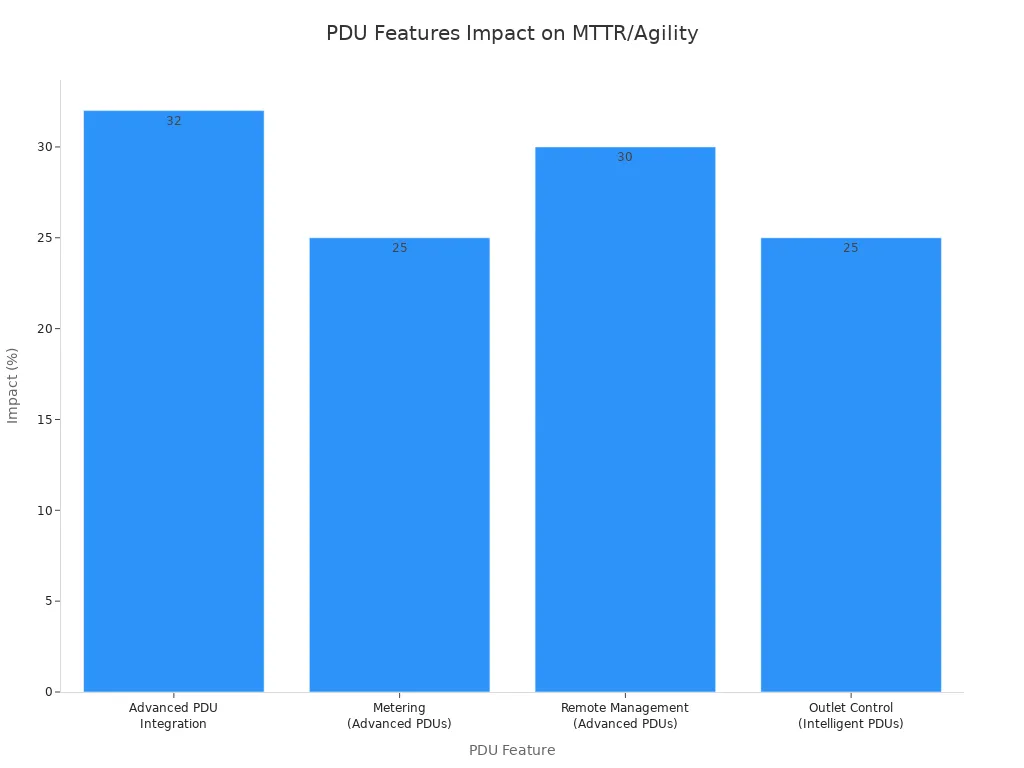
- Metering lets me track power use at different levels. This helps me manage energy and cut downtime.
- Remote Management means I can monitor and control power from anywhere. This makes us more agile and lets me fix problems before they get big.
- Outlet Control on intelligent PDUs lets me remotely power cycle individual outlets. This quickly fixes server issues and cuts downtime.
Driving Energy Efficiency
PDUs help me see exactly where power goes. When I know what’s using power, I can make smart choices. I can turn off devices that aren’t needed. I can also balance loads better, so no single circuit works too hard. This stops wasted energy. It also means our cooling systems don’t have to work as hard, saving even more energy. Ultimately, this saves money on electricity bills and helps us be more eco-friendly.
Facilitating Remote Management
Modern PDUs are way more than just power strips. They offer advanced remote monitoring and access. I can manage the electrical supply for huge businesses and data centers from anywhere.
- Rack-mounted PDUs often include Simple Network Management Protocol (SNMP) remote management tools.
- I get remote power control. I can turn outlets on or off, reboot devices, and watch power use without being on-site.
- Advanced power monitoring gives me real-time insights into energy use at both the unit and outlet levels. I also get detailed reports.
- I have extensive control, like individual outlet control, scheduled on/off switching, equipment rebooting, and power sequencing delays to prevent inrush currents.
- PDUs integrate with network management systems. This gives me a full picture of power distribution and environmental conditions.
- Remote monitoring and control at the outlet level means I can power cycle things remotely. This cuts down on needing to go on-site.
- Smart PDUs offer intelligent power management, advanced power metering, and environmental monitoring (temperature and humidity).
- They have strong security features, like SNMPv3, to stop unauthorized access.
- I can use a web interface for advanced remote monitoring. This gives me detailed data logs for analysis and diagnostics.
- Environmental Monitoring Probes (EMP) give me temperature and humidity values.
- They have different ways to connect, like Ethernet, RS485, and USB ports. They support SNMP, HTTP, and Telnet protocols, so they fit right into our network management systems.
- Power sequencing with time delays prevents circuit overloads and keeps outlets working during power cycles.
- TCP/IP networking support allows hybrid networking with up to 10 cascading devices. This means I can manage power across many units.
PDUs are super important for “lights-out management” in remote data centers. This means I can run a data center without anyone physically there.
- Intelligent or switched models let me remotely power cycle servers and other devices. I can troubleshoot and manage things from anywhere.
- This really cuts down server downtime. It also makes it cheaper to run remote sites that don’t have IT staff on-site.
- Basic PDUs give some info, but it’s the advanced features of intelligent and switched Rack PDUs, like outlet-level management, that give me the real remote control I need for effective lights-out management.
- Smart/Monitored PDUs let me remotely (via IP) monitor the state of the distribution unit.
- Switched PDUs also offer remote (IP) monitoring.
- Outlet Level Power Monitoring PDUs give me very detailed visibility into power consumption, plus remote power and environmental monitoring.
Supporting Scalability and Growth
PDUs are designed to grow with us.
- HPE G2 Basic PDUs offer 0U and 1U installation options. I can put them vertically on either side of the rack with outlets facing back, or side-by-side for more power density.
- Horizontal/Modular PDUs have a modular design. The control unit can go in 1U or 0U space, and extension bars attach right to the frame. This lets me put power access exactly where I need it.
- HPE G2 Metered PDUs also have many mounting options. I can install them on either side of the rack with outlets facing back, or side-by-side for higher power density. They work great with HPE racks and many other brands too.
- Raritan PX Intelligent PDUs are built to handle current and future growth. They have advanced tech and high power densities. Their strong design keeps things safe in dense cabinets, making them perfect for long-term infrastructure.
What features do I look for to handle future power demands?
- Modular PDUs make it easy to grow and adapt our systems. This saves money and gets us ready for what’s next.
- Smart PDUs offer live tracking, remote control, and energy-saving tools. They use IoT and AI for smarter operation and to avoid downtime.
- New PDUs can even work with renewable energy sources like solar panels and wind power. They manage energy flow smoothly for steady power.
- Custom PDUs solve problems like tight spaces, energy saving, and flexibility, particularly in data centers. They offer modular setups, better tracking, and eco-friendly features.
- Modern PDUs have advanced power monitoring. This tracks consumption in real-time, helps find issues, optimizes energy, and cuts costs.
- Remote management, often with IoT, lets me control power distribution from anywhere. This makes operations super flexible.
- Load balancing stops overloads and makes equipment last longer by spreading power efficiently.
- Environmental monitoring tracks temperature and humidity. This keeps equipment safe and extends its life.
- Scalability is a key part of their design. I can easily upgrade and expand as power needs grow in our data centers.
- Modular PDUs let me customize for current and future power needs. This gives great flexibility for dynamic places like data centers.
- Redundancy and reliability features, like redundant PDUs, cut downtime. They ensure continuous power even if one unit fails.
I see Power Distribution Units as indispensable. They ensure reliability and efficiency. For 2025, I know they will be key for future power demands. We need intelligent, modular PDUs with IoT and AI for predictive maintenance and sustainability. This helps manage high power density and integrate with smart systems.
FAQ
What is the main difference between a PDU and a power strip?
I see PDUs as much more advanced. They offer features like remote monitoring, individual outlet control, and higher power ratings. Power strips just give you more outlets.
Why do I need an “intelligent” PDU?
I use intelligent PDUs for remote control and monitoring. They help me manage power from anywhere. They also track environmental conditions and send alerts.
How do PDUs help save energy?
I use PDUs to track power use. This helps me turn off unused devices. It also balances loads better. This saves energy and lowers my electricity bills.
Post time: Jun-05-2025


