

Introduction
AI racks are pushing far beyond traditional server power profiles, turning rack-level distribution into a critical design decision rather than a commodity purchase. This article examines how Yosun’s smart PDU innovations address the higher densities, tighter uptime requirements, and greater monitoring demands of modern AI clusters. Readers will see why features such as real-time visibility, outlet-level control, thermal awareness, and scalable power architectures matter when supporting GPU-heavy deployments. The discussion also connects these technical capabilities to operational pressures, including efficiency, reliability, and capacity planning, setting up a clearer view of what next-generation data center power infrastructure now requires.
Why Yosun’s Smart PDU Strategy Matters for Next-Generation AI
Whenever data center operators discuss infrastructure today, the conversation inevitably turns to AI. We are not just dealing with standard web servers anymore; we are powering massive compute engines that devour electricity. That is why Yosun’s evolving power distribution strategy demands close attention.
How AI cluster power density is changing requirements
Traditional racks usually provision around 5kW to 10kW. However, with modern AI clusters running the latest NVIDIA or AMD accelerators, rack densities are spiking to anywhere between 40kW and 120kW. This is not just a slight bump; it fundamentally breaks legacy power architectures. You cannot simply plug these systems into standard strips and hope for the best. The sheer amperage required dictates robust, intelligent distribution right at the rack level to handle sustained draws without thermal failure.
Which commercial pressures increase the need for visibility and control
Beyond the physics, the commercial realities are brutal. The cost of downtime for an enterprise-grade AI training cluster can easily exceed $100,000 per hour. When running workloads that take weeks to complete, a tripped breaker is not just an inconvenience—it is a massive financial hit. Facilities are also under intense pressure to optimize their Power Usage Effectiveness (PUE) to meet strict ESG mandates. This commercial squeeze makes granular visibility and control absolutely non-negotiable. If you cannot measure your AI Infrastructure power draw down to the outlet, you simply cannot manage operational costs effectively.
What Defines a Smart PDU for AI Clusters

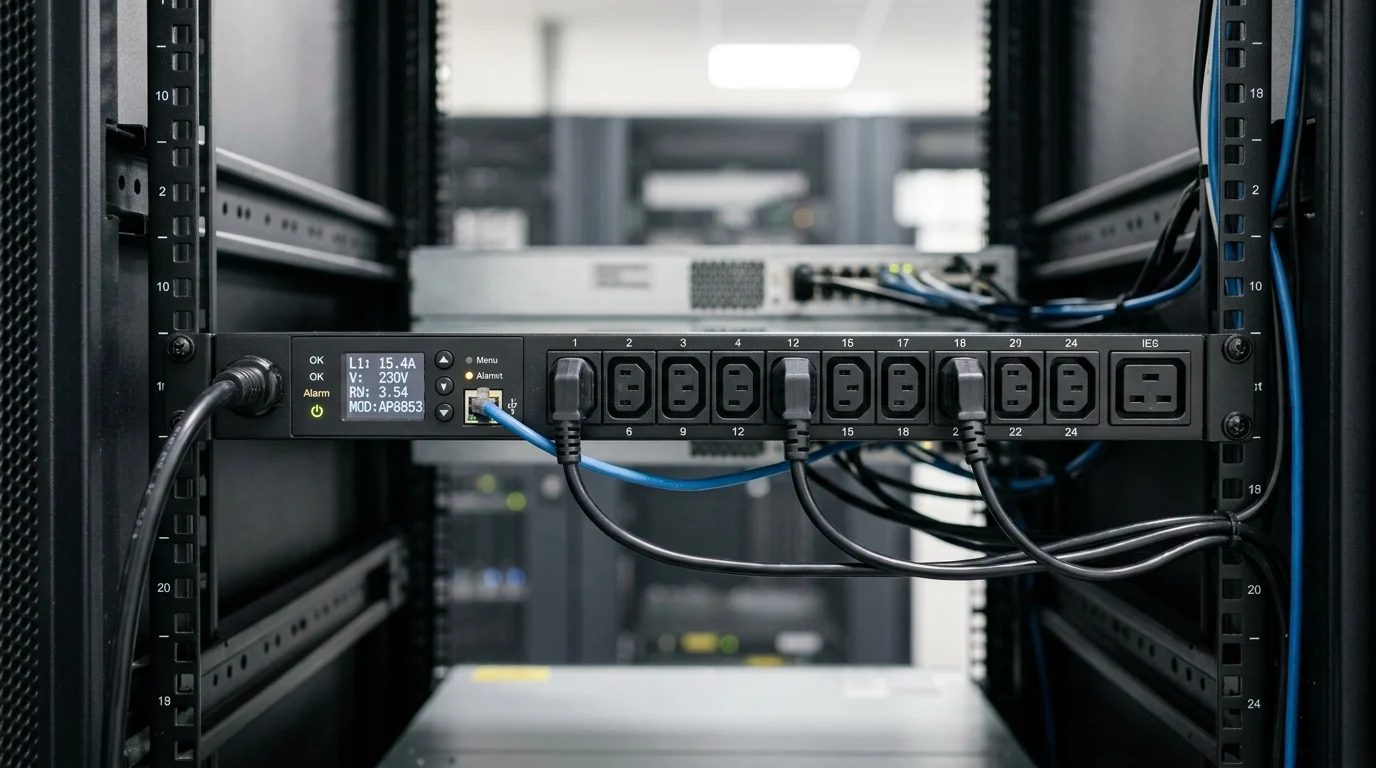
What actually elevates a power strip to the ‘smart’ category in the context of these high-stakes AI environments? A true Smart PDU functions as a highly specialized edge computer that happens to distribute electricity.
Which Smart PDU capabilities matter most
The most critical capability is billing-grade telemetry. This means ±1% metering accuracy for voltage, current, power, and energy consumption at both the phase and individual outlet levels. Add to that remote switching—which allows operators to hard-reboot a frozen GPU server remotely—and integrated environmental monitoring for temperature and humidity. Without these three pillars, administrators are flying blind when managing next-generation workloads.
How Yosun’s design compares with basic PDUs
Comparing Yosun’s intelligent designs to basic, unmanaged power strips reveals stark differences. Basic units merely pass electrons; smart units actively protect the hardware.
| Feature | Basic PDU | Yosun Smart PDU |
|---|---|---|
| Metering | None or local LED only | ±1% accuracy, outlet-level telemetry |
| Remote Control | Manual physical unplugging | Secure web/API outlet toggling |
| Alerting | None | Real-time SNMP/email alerts |
| Max Load Support | Typically capped around 16A-32A | Configurable up to 60A+ for AI loads |
It is clear that for any rack pulling serious wattage, the basic approach is a liability. The smart architecture is what allows operators to maintain uptime and peace of mind.
How Yosun’s Smart PDU Improves Reliability and Efficiency
Reliability is not just a buzzword when powering AI; it is the fundamental requirement. Yosun’s intelligent units are specifically designed to keep these demanding clusters running efficiently.
Which electrical, thermal, and monitoring specifications matter
AI workloads run extremely hot, often turning the back of a rack into an oven. Yosun units are engineered to support continuous operating temperatures up to 60°C (140°F) without any derating of their power capacity. On the electrical side, they utilize high-retention locking outlets (such as standard C13 and high-capacity C19) with a defect rate of less than 0.1%. This ensures that heavy, vibrating cooling fans do not slowly wiggle cables loose over time.
How a Smart PDU supports capacity planning and load balancing
Capacity planning is another area where these units excel. Real-time telemetry allows operators to track phase balancing across three-phase deployments. If a phase imbalance hits a user-defined threshold—for example, 15%—the PDU fires off an alert before a breaker trips. This proactive monitoring safely packs more compute into a rack without stranding power capacity, effectively maximizing the return on investment for the white space.
Which integration points with DCIM, BMS, and remote management matter
A smart device is only as useful as its ability to communicate with the rest of the building. Robust integration with Data Center Infrastructure Management (DCIM) and Building Management Systems (BMS) is essential. Yosun supports SNMP v3, Modbus TCP, and modern RESTful APIs like Redfish. Whether utilizing legacy monitoring tools or a custom-built dashboard for AI Data Center Power, the data flows seamlessly and securely.
What Buyers Should Compare When Selecting a Yosun Smart PDU
During the procurement phase, the sheer number of available SKUs can be overwhelming. Evaluating and comparing different Yosun configurations ensures the deployment meets exact facility needs.
Which criteria best differentiate Smart PDU options
The primary differentiators usually come down to form factor, outlet density, and input feeds. For AI, operators almost exclusively look at 0U (vertical) units because rack space is too precious for horizontal power distribution.
| Specification | Standard Enterprise | High-Density AI Cluster |
|---|---|---|
| Input Amperage | 30A / 32A | 60A / 63A+ (Three-Phase) |
| Outlet Mix | Mostly C13, few C19 | Heavy C19/C39 for high-draw nodes |
| Form Factor | 1U or standard 0U | Extended 0U with high-temp rating |
Matching the plug type and breaker configuration exactly to the facility’s power whips is critical for a smooth deployment.
How cost, customization, and lead times affect selection
Logistics also play a major role. High-density intelligent units are premium products, and pricing scales with outlet-level metering capabilities. If a completely custom layout is required—such as a specific alternating phase arrangement to match custom High Power PDU server chassis—Yosun can build it. However, buyers should expect a Minimum Order Quantity (MOQ) of around 50 units and a lead time of 4 to 6 weeks. For tighter schedules, standard high-density SKUs are usually stocked and ready to ship, saving significant time during a fast-tracked cluster build.
How to Evaluate Whether Yosun’s Smart PDU Fits Your Deployment

How do you validate that these units are the right fit for a specific facility? A structured evaluation process is always more reliable than simply trusting a spec sheet.
Which evaluation steps help validate selection
The best first step is a Proof of Concept (POC). Running one or two units in a test rack for 30 days is highly recommended. During this time, evaluators should intentionally simulate fault conditions: unbalance the load, push the temperature up, and test the remote reboot latency. This window also allows the network team to validate API integrations and security protocols. If the unit passes a rigorous 30-day stress test without dropping a packet or a watt, it is ready for production.
Which deployment scenarios are the best fit
Ultimately, these advanced units are best suited for environments where the stakes are highest. While overkill for a basic wiring closet, deploying 30kW+ liquid-cooled racks in a colocation facility or building an on-prem enterprise AI sandbox makes the investment pay for itself the first time a catastrophic outage is avoided. Integrating Yosun Smart Solutions provides the critical layer of visibility needed to push modern hardware to its limits safely. The transition to AI-driven compute is accelerating, and upgrading foundational power infrastructure is the only way facilities can keep pace with the demands of the next decade.
Key Takeaways
- The most important conclusions and rationale for Smart PDU
- Specs, compliance, and risk checks worth validating before you commit
- Practical next steps and caveats readers can apply immediately
Frequently Asked Questions
What makes a smart PDU essential for AI clusters?
AI racks often run 40kW–120kW, far above basic PDU limits. A smart PDU adds outlet-level metering, remote control, and alerts to prevent overloads and reduce downtime.
How does Yosun’s Smart PDU improve uptime in dense racks?
It provides real-time phase and outlet monitoring, remote rebooting, and threshold alerts. This helps operators catch imbalances early and restore unresponsive servers without visiting the rack.
Which Yosun Smart PDU features matter most for AI workloads?
Look for ±1% billing-grade metering, outlet switching, SNMP or email alerts, and temperature or humidity monitoring. These features support safer operation and clearer capacity planning.
Can Yosun Smart PDUs handle high-temperature AI environments?
Yes. The article notes Yosun units support continuous operation up to 60°C without derating, helping maintain reliable power delivery in hot, high-density AI racks.
How can I choose the right Smart PDU on yosunpdu.com?
Start with rack load, input type, phase requirement, and outlet mix such as C13 or C19. Then compare Yosun smart PDU models for amperage, telemetry, and remote management support.
Post time: May-19-2026


