

Introduction
As rack power density climbs from legacy 5kW footprints to 20kW, 30kW, or more, a metered PDU becomes a core part of uptime planning rather than a basic accessory. The right unit does more than distribute power: it gives you real-time visibility into load levels, helps prevent circuit overloads, and supports smarter capacity planning as equipment changes. This article explains how to evaluate a metered PDU for high-density server racks, including electrical capacity, outlet configuration, monitoring needs, and safety margins, so you can match the device to actual rack demand and reduce the risk of costly downtime.
Why choosing the right Metered PDU matters in high-density racks
I remember when a standard server rack barely pulled 5kW. Fast forward to today, and I routinely see AI and database clusters pushing rack densities past 20kW, and sometimes even hitting the 40kW mark. At those extremes, power distribution isn’t just a plug-and-play afterthought; it is a critical failure point if you get it wrong.
Managing that kind of power footprint requires a strategic approach. If your hardware draws more current than the distribution unit can handle, you are facing catastrophic downtime. Choosing the right equipment means looking beyond the plugs and understanding how power moves through your infrastructure.
How to frame Metered PDU selection
When I approach selecting a High-density PDU, I frame the decision around risk mitigation and capacity planning. You aren’t just buying a fancy power strip; you are investing in visibility. If you load a 30-amp circuit to 29 amps without knowing it, the next server spin-up spike will trip your breaker and take down the entire rack.
You need to understand the difference between peak load and continuous load. The National Electrical Code (NEC) mandates that continuous loads must not exceed 80% of a circuit’s maximum rating. That means a standard 30-amp circuit can only safely deliver 24 amps continuously. Framing your choice means looking at your current peak load, adding a 20% to 30% safety buffer, and ensuring your unit can actively report on that utilization.
What a Metered PDU is and why it matters
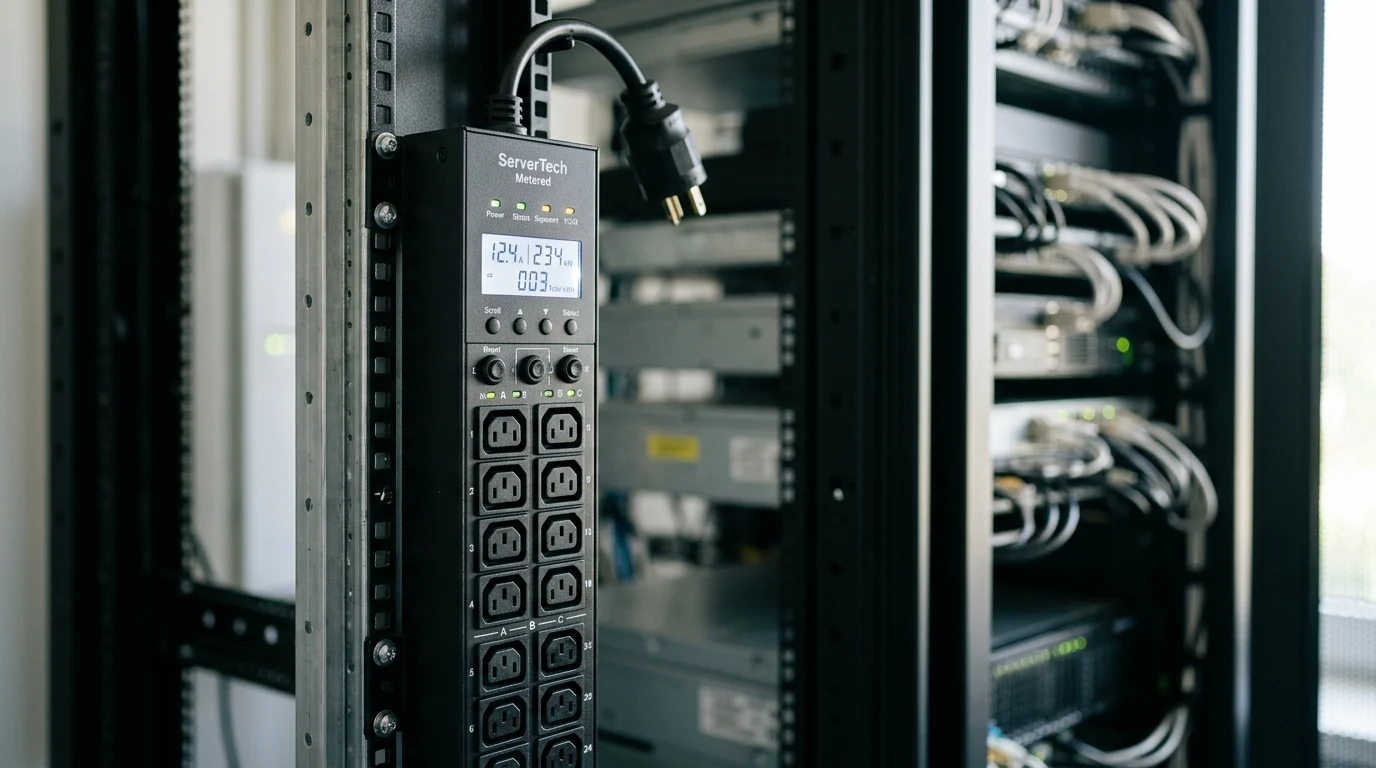
So, what exactly sets a metered unit apart? While basic PDUs just pass electricity, a metered unit actively measures voltage, amperage, real power (kW), and apparent power (kVA). Some models only feature a local LED display, but I always recommend networked units that feed data directly to your DCIM software.
It matters because high-density equipment demands precision. When you monitor Server Room Power down to the phase or branch circuit level, you can safely deploy hardware up to that 80% continuous load threshold without losing sleep over unexpected outages. Furthermore, modern metered units often include environmental sensor ports, allowing you to track temperature and humidity right alongside your electrical draw.
Which Metered PDU specifications to compare first

Once you understand the stakes, it is time to dig into the spec sheets. I always start by looking at the physical constraints of the rack and the electrical feed coming from the UPS.
Choosing the wrong form factor can lead to blocked exhaust fans or impossible cable routing. You need to ensure the physical dimensions align perfectly with your rack’s cable management system, whether you need a horizontal unit or a towering vertical model.
How to evaluate input power, outlet mix, phase type, and branch circuits
First, evaluate your input power. For high-density racks, 120V single-phase is dead. You will be looking at 208V single-phase or, ideally, 208V/400V 3-phase power to handle loads up to 22kW or more per whip. Next, map out your outlet mix. A typical high-density 0U Metered PDU might offer 36x IEC C13 outlets for standard servers and 6x to 12x IEC C19 outlets for blade chassis or heavy-duty switches.
Pay close attention to the branch circuits. A 60A 3-phase unit will divide power into multiple 20A branch circuits, each protected by its own circuit breaker. You need to balance your servers across these branches so no single 20A line exceeds its 16A continuous limit. Color-coded receptacles are another feature I highly recommend here; having alternating color blocks makes it infinitely easier to visually load-balance your servers.
What comparison table to use for Metered PDUs
To keep things straight, I use a quick comparison matrix when evaluating options. Below is the framework I rely on to compare typical high-density configurations, whether I am sizing a massive vertical unit or a specialized 1U Rack PDU for top-of-rack network switches.
| Specification | Mid-Density Rack (10-15kW) | High-Density Rack (15-30kW+) |
|---|---|---|
| Input Voltage | 208V Single-Phase | 208V or 400V 3-Phase |
| Input Amperage | 30A or 50A | 50A or 60A |
| Outlet Mix | Mostly C13, 2-4x C19 | High-count C13 & 6-12x C19 mix |
| Circuit Breakers | 2x 20A breakers | 6x 20A low-profile breakers |
| Operating Temp | Up to 45°C (113°F) | Up to 60°C (140°F) for hot aisles |
How to choose the best Metered PDU for your rack

Now that we know the specs, how do we actually pull the trigger? Making the final call requires a structured approach so you do not end up overpaying for features you will not use, or worse, under-provisioning your rack.
It is easy to get distracted by flashy marketing terms, but your focus should remain firmly on reliability and integration capabilities. You need to verify that the unit supports secure protocols like SNMPv3 and integrates smoothly with your existing management dashboard.
What step-by-step process to follow
I always follow a strict four-step process. Step one: Calculate your total Power Capacity requirements by summing the nameplate wattage of all devices, then derating by 20% for real-world continuous load. Step two: Check your rack space. If you have deep servers, a bulky unit might block airflow, so look for low-profile chassis designs under 2.5 inches wide.
Step three: Count your plugs and add a 20% buffer for future expansion—if you need 30 outlets today, buy a 36-outlet model. Finally, step four: Check the ambient temperature rating. High-density racks run hot, and you will want a unit rated for at least 60°C (140°F) to survive in the hot aisle containment zone. Do not forget to account for cord length; a standard 10-foot whip might be too short if your overhead busway is positioned awkwardly.
How to balance price, capacity, and features
Balancing price, capacity, and features is the ultimate trade-off. You must weigh upfront costs against the long-term reliability and visibility required to keep your high-density infrastructure running safely.
Key Takeaways
- The most important conclusions and rationale for Metered PDU
- Specs, compliance, and risk checks worth validating before you commit
- Practical next steps and caveats readers can apply immediately
Frequently Asked Questions
What is the main benefit of a metered PDU in a high-density rack?
It gives real-time load visibility, helping you avoid overloads, balance circuits, and plan capacity before a breaker trips.
How much load should I place on a metered PDU continuously?
Follow the 80% rule: a 30A circuit should carry no more than 24A continuously, with extra headroom for startup spikes.
Which input power is best for high-density server racks?
For most high-density racks, choose 208V single-phase or, better, 208V/400V 3-phase to support higher kW per rack efficiently.
What outlet mix should I choose for a metered PDU?
Match your equipment: use mostly IEC C13 for standard servers and add enough IEC C19 outlets for blade servers, storage, or high-draw switches.
Does YOSUN offer metered PDUs for 0U and 1U rack deployments?
Yes. YOSUN provides metered PDU options for vertical 0U and horizontal 1U installations, plus outlet and accessory choices for different rack layouts.
Post time: May-07-2026


