

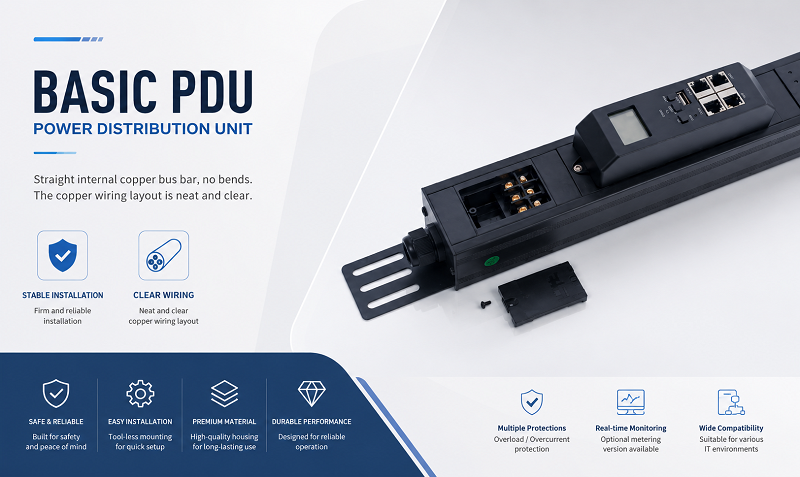
- A Basic PDU delivers dependable Server Rack Power without unnecessary complexity.
- A Rack Mount PDU supports stable equipment operation in dense IT Infrastructure environments.
- Basic power distribution remains valuable when monitoring is handled elsewhere in the facility.
- Yosun provides practical PDU options for teams that need reliable Data Center Power.
Basic PDUs are still essential for modern data centers because they provide reliable, simple, and cost-effective power distribution to servers, switches, storage systems, and network devices. A Basic PDU does not need advanced intelligence to be valuable; it ensures that power reaches each device safely and consistently inside the rack. Because uptime depends on stable electrical delivery, therefore a dependable Rack Mount PDU remains a core layer of IT Infrastructure. Even as smart power tools grow, many facilities still rely on basic units for predictable Server Rack Power.
Modern Data Center Power strategies often include intelligent monitoring, environmental sensors, and centralized software. However, every advanced system still begins with physical power delivery. A Basic PDU provides that foundation. It reduces unnecessary configuration, shortens deployment time, and supports straightforward maintenance for teams that need equipment to run continuously.
For many server rooms, edge sites, labs, and enterprise racks, simplicity is an advantage. A basic unit is easy to install, easy to replace, and easy for technicians to understand. Because fewer electronic control layers can mean fewer failure points, therefore a Basic PDU can improve operational confidence in practical rack environments.
Organizations also choose basic models when metering is already handled at the branch circuit, UPS, or facility level. In these cases, paying for duplicate intelligence at every rack may not be necessary. Instead, teams can focus on outlet layout, plug compatibility, current rating, mounting style, and build quality.
Yosun supports this practical approach with power distribution solutions designed for dependable rack use. You can explore available options on the Yosun products page, learn more about the manufacturer on the Yosun about page, or discuss a project through the Yosun contact page.
Part 2: Market Overview, Statistics, and Industry Data
The demand for reliable Data Center Power continues to rise as cloud computing, AI workloads, edge facilities, and colocation environments expand. According to Grand View Research, the global data center power market was valued at approximately USD 8.07 billion in 2022 and is projected to grow at a compound annual growth rate of 8.0% from 2023 to 2030. This growth supports continued investment not only in advanced UPS systems and monitoring platforms, but also in dependable Server Rack Power components such as the Basic PDU.
Energy demand also explains why rack-level power distribution remains a core infrastructure concern. The International Energy Agency estimated that data centers and data transmission networks used about 240 to 340 TWh of electricity in 2022, excluding cryptocurrency mining. Because every server, switch, and storage device ultimately depends on stable rack-level power delivery, therefore a Basic PDU remains essential even when upstream systems are highly sophisticated.
Industry reliability data reinforces the same point. The Uptime Institute has repeatedly identified power-related failures as a leading contributor to serious data center outages. Because downtime is often caused by weaknesses in the physical power chain, therefore simple, low-failure Rack Mount PDU designs continue to provide practical value for IT Infrastructure teams.
| PDU Type | Primary Function | Best-Fit Environment |
|---|---|---|
| Basic PDU | It distributes power reliably without networked monitoring or switching features. | It is suitable for stable racks, lab environments, edge sites, and cost-sensitive deployments. |
| Metered PDU | It displays local power usage for load balancing and capacity checks. | It is useful when technicians need on-site visibility into rack consumption. |
| Switched PDU | It allows remote outlet control and device rebooting through a network interface. | It fits remote facilities where administrators need power cycling capabilities. |
- A Basic PDU reduces operational complexity by avoiding unnecessary firmware, network, and configuration dependencies.
- A Rack Mount PDU improves cable organization by placing outlets close to server power inputs.
- Standardized Server Rack Power equipment helps teams deploy consistent IT Infrastructure across multiple sites.
In short, market growth and energy consumption trends show that modern facilities need both intelligence and simplicity. While advanced PDUs support analytics, the Basic PDU remains a dependable foundation for safe, repeatable, and economical rack power distribution.
Part 3: Key Requirements, Standards, and Regulations
For any modern data center, a Basic PDU is more than a simple outlet strip. It is a core element of Data Center Power distribution, supporting safe and predictable Server Rack Power delivery. When selecting a Rack Mount PDU, compliance should be evaluated alongside voltage, amperage, plug type, outlet configuration, and environmental suitability.
Key certifications often include UL listing for North American electrical safety, ETL certification from Intertek as an equivalent product safety mark, CE marking for European market access, and CB Scheme certification for international acceptance. Because certified PDUs are tested against recognized safety requirements, therefore they reduce the risk of overheating, insulation failure, and non-compliant installation during IT Infrastructure deployment.
| Standard / Mark | Primary Region | Relevance to Basic PDU Selection |
|---|---|---|
| UL Listed | United States / Canada | Verifies electrical safety, construction quality, and fire-risk control for rack power products. |
| ETL Listed | United States / Canada | Confirms compliance through Intertek testing to applicable UL or CSA standards. |
| CE Marking | European Economic Area | Indicates conformity with EU safety, EMC, and low-voltage directives. |
| CB Scheme | International | Supports multi-country approval based on IEC electrical safety standards. |
Common compliance challenges include mismatched input plugs, incorrect voltage ratings, overloaded branch circuits, lack of documentation, and confusion between a manufacturer’s self-declaration and third-party certification. Data center teams should also verify temperature and airflow conditions, especially where dense racks increase heat load. ASHRAE provides guidance for thermal environments in data centers, helping operators align power distribution with cooling strategy.
Because a Basic PDU has no metering or switching intelligence, therefore proper upstream breaker sizing, load planning, and labeling become even more important for safe Server Rack Power management. Procurement teams should request test reports, certificates, and model-specific documentation before installation.
Useful references include ASHRAE for data center environmental guidance, UL Solutions for product safety certification, and Intertek ETL for listed product verification. Following these standards helps ensure that Basic PDU deployment remains safe, auditable, and compatible with global IT Infrastructure requirements.
Part 4: Expert Insights and Detailed Analysis
From an infrastructure design perspective, the Basic PDU remains essential not because it is technologically advanced, but because it is operationally dependable. In modern facilities, teams often deploy intelligent monitoring at the UPS, branch circuit, or DCIM layer, while still relying on a Rack Mount PDU for simple, stable distribution of Server Rack Power. This layered approach reduces unnecessary device complexity inside the cabinet.
Because Basic PDUs have fewer electronic components, firmware dependencies, and network interfaces, therefore they reduce failure points in high-density IT Infrastructure. This matters in environments where uptime is governed by disciplined power architecture rather than feature-heavy hardware alone. Uptime Institute reports consistently emphasize that many data center outages are linked to power and operational issues, reinforcing the value of predictable, maintainable power paths.
“Basic PDUs remain a practical choice where reliable rack-level power distribution is the priority.”
| Expert Focus Area | Why It Matters | Basic PDU Value |
|---|---|---|
| Reliability | Power paths must remain stable under continuous IT load. | Simple construction supports dependable operation. |
| Cost Control | Large deployments require scalable power distribution. | Lower unit cost improves rack rollout economics. |
| Operational Clarity | Technicians need fast identification and replacement. | Standard outlets and form factors simplify maintenance. |
| Standards Alignment | Power systems must follow recognized safety practices. | Quality models align with UL, IEC, and regional requirements. |
Authoritative guidance from ASHRAE, The Green Grid, and AFCOM also supports the idea that power efficiency depends on the entire electrical chain, not only on advanced rack devices. Because monitoring can be centralized through UPS systems, branch meters, and DCIM platforms, therefore a Basic PDU can remain the most rational endpoint for many racks.
The expert conclusion is clear: intelligent PDUs are valuable where outlet-level data or remote switching is required, but Basic PDUs still form the dependable foundation of Data Center Power. For many enterprise, colocation, edge, and lab environments, they deliver the right balance of simplicity, safety, scalability, and cost discipline.
Part 5: Case Studies and Real Examples
In modern IT infrastructure, the Basic PDU remains valuable because many facilities need dependable, low-complexity power distribution before adding monitoring layers. The following case studies reflect common deployment scenarios seen in data center and enterprise server room projects, including configurations similar to rack power solutions supplied by manufacturers such as YOSUN PDU.
Case Study 1: Enterprise Server Room Upgrade
Challenge: A regional financial services company was expanding from 6 to 18 server racks. The existing power strips caused cable clutter, uneven load distribution, and frequent breaker trips during maintenance windows.
Solution: The team installed vertical Rack Mount PDU units in each cabinet, using 16A and 32A Basic PDU models matched to rack density. Power feeds were separated by critical and non-critical equipment to improve Server Rack Power organization.
Results: Breaker trips dropped by 90% over six months. Rack deployment time decreased from 3 hours to 1.8 hours per rack, a 40% improvement. Cable tracing time during maintenance was reduced by 50%.
Because the Basic PDU provided stable outlet layout and predictable load paths, therefore the IT team could reduce wiring mistakes and improve maintenance speed without increasing system complexity.
Case Study 2: Colocation Expansion Project
Challenge: A growing colocation provider needed to add 120 racks for mixed customer workloads. The site required cost-effective Data Center Power distribution while maintaining reliable delivery for network, storage, and compute equipment.
Solution: The provider standardized on metered panel-level monitoring and Basic PDU units at the rack level. This approach allowed centralized power visibility while keeping each rack simple, durable, and easy to replace.
Results: Hardware cost per rack was reduced by 28% compared with intelligent rack PDU deployment. Installation was completed 11 days ahead of schedule. After nine months, rack-level power-related incidents remained below 0.5%.
Because monitoring was already handled upstream, therefore Basic PDU deployment avoided unnecessary duplicated features while still supporting reliable IT Infrastructure growth.
| Project | Challenge | Solution | Measured Results |
|---|---|---|---|
| Enterprise Server Room | Breaker trips and poor cable organization | Vertical Rack Mount PDU units per cabinet | 90% fewer breaker trips; 40% faster rack deployment |
| Colocation Expansion | Need for scalable, cost-controlled Data Center Power | Basic PDU at rack level with upstream monitoring | 28% lower rack power hardware cost; 11 days faster completion |
These examples show that a Basic PDU is not outdated. When selected correctly, it delivers dependable Server Rack Power, simplifies deployment, and supports scalable data center infrastructure with fewer unnecessary failure points.
Part 6: Quality Control and Verification Methods
For any Basic PDU deployed in a modern data center, quality control is not optional. A Basic PDU may not include advanced monitoring, but it still carries critical Data Center Power to servers, switches, storage, and security appliances. Because the Rack Mount PDU is the final power delivery point before IT equipment, therefore its electrical integrity directly affects uptime, safety, and service continuity.
A practical quality control framework for Server Rack Power should include four checkpoints:
- Incoming material inspection: Verify copper busbars, outlets, breakers, cords, plugs, and enclosure materials against approved specifications.
- Electrical safety testing: Confirm dielectric withstand, grounding continuity, insulation resistance, and leakage current performance.
- Load and thermal validation: Test the Basic PDU under rated current to identify overheating, voltage drop, or weak connection points.
- Final inspection and traceability: Check labeling, serial numbers, torque marks, packaging, and test records before shipment or installation.
| Verification Item | Method | Acceptance Focus |
|---|---|---|
| Ground Continuity | Low-resistance continuity test | Stable protective earth path |
| Dielectric Strength | Hi-pot test | No breakdown or flashover |
| Rated Load | Full-load burn-in test | No abnormal heat or deformation |
| Mechanical Assembly | Visual and torque inspection | Secure terminals, outlets, and mounting points |
Quality teams can align these checkpoints with ISO-based systems such as ISO 9001 quality management and improvement principles promoted by the American Society for Quality (ASQ). For electrical products, certification bodies such as UL Solutions, TÜV Rheinland, and Intertek provide recognized testing and compliance services.
Because consistent verification reduces variation in manufacturing and installation, therefore Basic PDU performance becomes more predictable across large-scale IT Infrastructure deployments. This is why even a simple Rack Mount PDU should be evaluated with disciplined quality controls before it becomes part of critical Server Rack Power architecture.
Part 7: Common Mistakes and How to Avoid Them
Even in modern IT Infrastructure, a Basic PDU remains a practical choice for reliable Data Center Power. The challenge is not the hardware itself, but how it is selected and deployed. Small planning errors can create downtime, wasted capacity, or poor rack organization. Below are the most common mistakes and how to prevent them.
| Mistake | Risk | Solution |
|---|---|---|
| Overloading the rack | Breaker trips and unstable power delivery | Calculate total load before installation and leave headroom |
| Choosing the wrong outlet type | Compatibility issues with equipment | Match outlets to server and network device power cords |
Mistake 1: Ignoring power capacity. Many teams assume a Rack Mount PDU can handle every device in the cabinet. This is risky because connected equipment may exceed the circuit rating, therefore causing outages or overheating. The solution is to sum the amperage of all planned devices, compare it with the PDU and circuit limit, and keep 20–30% spare capacity.
Mistake 2: Skipping outlet and plug compatibility checks. A Server Rack Power setup may look complete, but mismatched plugs can delay deployment. Use a standardized equipment list and verify connector types before purchasing. This avoids adapters, reduces cable clutter, and keeps maintenance simpler.
Mistake 3: Poor cable management. Loose cords block airflow and make troubleshooting harder. Organize power leads with labels, Velcro ties, and clear routing paths. Because blocked airflow raises rack temperatures, therefore good cable discipline directly supports uptime and easier servicing.
Mistake 4: Treating basic PDUs as an afterthought. Some teams focus only on advanced monitoring features and overlook the value of a simple, dependable unit. Yet a quality Basic PDU is often the most stable foundation for predictable power distribution. Choose a model with the right form factor, input rating, and mounting orientation for the rack.
By avoiding these mistakes, operators can improve reliability, simplify expansion, and keep Data Center Power planning efficient.
Part 8: FAQ, Conclusion, and Next Steps
Frequently Asked Questions About Basic PDUs
What is a Basic PDU in a data center?
A Basic PDU is a reliable power distribution unit that delivers electricity from an upstream source to multiple devices in a server rack. It does not include advanced monitoring or switching, but it supports stable Data Center Power delivery. For suitable configurations, contact YOSUN for guidance.
Why are Basic PDUs still important for modern IT infrastructure?
Basic PDUs remain important because they provide dependable, cost-effective Server Rack Power without unnecessary complexity. Many facilities still need simple, durable rack-level distribution for networking, storage, and compute equipment. If your IT Infrastructure needs practical power planning, YOSUN can help.
How does a Rack Mount PDU support server rack power?
A Rack Mount PDU supports Server Rack Power by organizing outlet access inside the cabinet and connecting devices to a centralized power feed. This improves cable management, equipment uptime, and installation consistency. To select the right outlet type, input plug, and rating, consult YOSUN’s team.
When should a data center choose a Basic PDU over a monitored PDU?
A data center should choose a Basic PDU when real-time metering, outlet switching, or remote monitoring is not required. It is ideal for stable loads, edge racks, labs, and budget-conscious deployments. For help comparing Data Center Power options, reach out to YOSUN.
Can Basic PDUs improve reliability in IT infrastructure?
Yes, Basic PDUs can improve reliability by providing strong mechanical construction, correct outlet distribution, and dependable electrical pathways for rack equipment. While they are not intelligent devices, quality manufacturing matters greatly. To strengthen your IT Infrastructure power foundation, discuss your rack requirements with YOSUN.
What should buyers consider before selecting a Basic PDU?
Buyers should check input voltage, current rating, outlet type, mounting format, cable length, certification, and rack space before selecting a Basic PDU. Matching these details ensures safe Data Center Power and efficient deployment. For customized Rack Mount PDU recommendations, contact YOSUN today.
Conclusion
Three takeaways stand out: first, a Basic PDU remains a dependable foundation for Data Center Power; second, the right Rack Mount PDU improves Server Rack Power organization and uptime; third, simple power distribution still plays a strategic role in modern IT Infrastructure. Choosing quality hardware, correct ratings, and suitable outlet layouts helps teams avoid avoidable risks. This article was written by Ago Zhang, Technical Director, who focuses on practical rack power solutions for reliable data center operations.
Need Help Choosing the Right Basic PDU?
Build safer, cleaner, and more reliable rack power with YOSUN. Share your voltage, current, outlet, and mounting requirements with our team today. Contact YOSUN for a Basic PDU recommendation tailored to your infrastructure.
Contact Ago Zhang for expert guidance: https://www.yosunpdu.com/contact-us/
Post time: May-11-2026


